Yield Estimation of the 2020 Beirut Explosion
We submitted an unclassified unlimited release (UUR) report to arXiv discussing our approach to improving multimodal data fusion accuracy by scaling the significance of each input dataset by a learned trust weight. This work uses seismic, SAR, streetview, and news report data sources about the 2020 Beirut warehouse explosion to estimate the magnitude of the blast.
Abstract
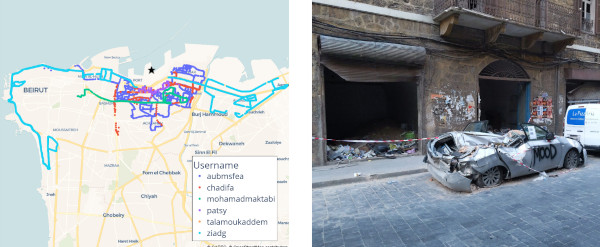
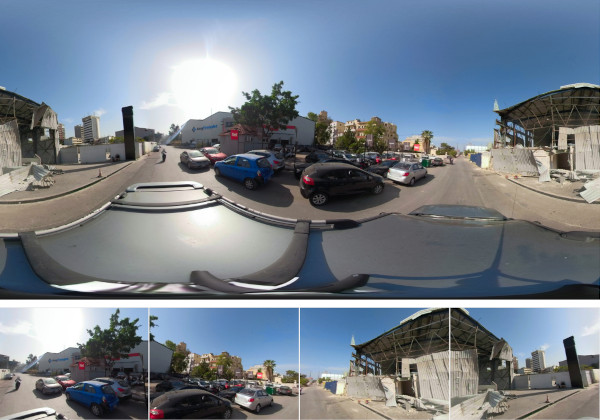
The estimation of explosive yield from heterogeneous observational data presents fundamental challenges in inverse problems, particularly when combining traditional physical measurements with modern artificial intelligence-interpreted modalities. We present a novel Bayesian fractional posterior framework that fuses seismic waves, crater dimensions, synthetic aperture radar imagery, and vision-language model interpreted ground-level images to estimate the yield of the 2020 Beirut explosion. Unlike conventional approaches that may treat data sources equally, our method learns trust weights for each modality through a Dirichlet prior, automatically calibrating the relative information content of disparate observations. Applied to the Beirut explosion, the framework yields an estimate of 0.34-0.48 kt TNT equivalent, representing 12 to 17 percent detonation efficiency relative to the 2.75 kt theoretical maximum from the blast's stored ammonium nitrate. The fractional posterior approach demonstrates superior uncertainty quantification compared to single-modality estimates while providing robustness against systematic biases. This work establishes a principled framework for integrating qualitative assessments with quantitative physical measurements, with applications to explosion monitoring, disaster response, and forensic analysis.
Publication
- arXiv:2511.16816 Lekha Patel, Craig Ulmer, Stephen J. Verzi, Daniel J. Krofcheck, Indu Manickam, Asmeret Naugle, and Jaideep Ray, "Trust-Aware Multimodal Data Fusion for Yield Estimation: A Case Study of the 2020 Beirut Explosion", arXiv:2511.16816.